Every question you had but didn't know who to ask.
Nano-coatings can get technical fast — the terminology, the product choices, the application details. We’ve answered the most common questions in plain English, so you can find what you need without having to ask. Can’t find what you’re looking for? Our engineers are one message away.
From product basics to application specifics — everything you need to know before you buy, trial, or specify.
What is a superhydrophobic surface?
A superhydrophobic surface is one where the contact angle to water exceeds 150°. To put that in perspective — on a smooth solid surface, the maximum contact angle chemistry alone can give you is around 130°. To go beyond that, the surface needs to be physically roughened at a micro or nano scale, in addition to being chemically treated.
Two things must both be true for a surface to qualify as superhydrophobic:
Water contact angle greater than 150°
The surface is micro or nano structured
What’s actually happening: the roughened texture traps tiny pockets of air. Water sits on a composite of air and solid rather than touching the surface directly — and this is what creates extreme repellency. The coating’s low surface energy chemistry does the rest.
One important caveat: many products in the market are labelled “superhydrophobic” when they are simply hydrophobic. The distinction matters for performance — and we’ll always be straight with you about which category a product falls into.
What are the benefits of superhydrophobic coatings?
Extreme water repellency is the headline benefit — water rolls off almost instantly, carrying dissolved contaminants and particulates with it. This self-cleaning effect is valuable across a wide range of applications.
Beyond water repellency, two other benefits are significant:
Reduced drag. A superhydrophobic surface has a much higher affinity for air than for water. When water flows over it, the resistance is defined more by the viscosity of water-air interaction than by the solid surface itself — which lowers the coefficient of friction and reduces drag.
Ice and snow repellency. The low surface tension properties of a superhydrophobic coating make it harder for ice and snow to grip the surface. It’s important to be clear here: these coatings don’t prevent ice from forming. What they do is encourage ice and snow to slide off rather than accumulate and bond. Think of it as “ice release” rather than “ice prevention.”
What are the limitations of superhydrophobic coatings?
Despite the volume of scientific literature on superhydrophobic performance, most commercial superhydrophobic surfaces have real-world limitations that are worth understanding before you specify one.
Because superhydrophobicity depends on a composite structure of roughened surface plus low surface energy chemistry, abrasive forces can damage that structure — and once the micro or nano texture is compromised, the level of hydrophobicity drops with it.
This is a genuine constraint for applications that involve repeated physical contact or handling. A good example: a portable man-pack SATCOM antenna needs strong water repellency to prevent rain fade and signal attenuation, but it also gets handled frequently and sometimes roughly. In cases like this, a hard, abrasion-resistant, RF-transparent hydrophobic coating is typically a better specification than a superhydrophobic one — and that’s exactly the kind of guidance we provide.
What superhydrophobic products are available?
VIRIDYN SH-2 is a two-step superhydrophobic coating designed for marine and ground-based microwave antennas, 5G antennas, radomes, and other telecom infrastructure. It prevents rain fade by keeping antenna surfaces clear of water and contamination. It also significantly reduces snow and ice accumulation.
VIRIDYN SH-1 is a one-step superhydrophobic coating for applications where a simpler application process is preferred.
If you have a specific technical challenge that superhydrophobic chemistry could solve, talk to us. ViriDyn may have already developed a solution for it, or can engineer one.
What is a hydrophobic surface?
A hydrophobic surface is literally a “water-fearing” surface. When water contacts it, it recedes rather than spreading — minimising the area of contact and forming droplets instead of a film.
The measure used is the contact angle: the angle formed between the solid surface and the tangent to the curve of a liquid droplet sitting on it. The greater the difference between the surface energy of the substrate and the surface tension of the liquid, the higher this angle, and the more readily the surface repels liquid.
By definition, a hydrophobic surface has a water contact angle greater than 90°.
What are the applications for hydrophobic coatings?
Hydrophobic coatings perform across several critical application areas:
Conformal Coatings for Electronics – VIRIDYN 101-X is a masking-optional conformal coating that provides industry-leading protection against corrosion and tin whisker formation on PCBs, ball grid arrays, and semiconductors.
Sensors and Optical Lenses – VIRIDYN DX is an optically transparent, abrasion and corrosion resistant coating for high-performance optical lenses, harsh-environment sensors, and ruggedised electronics.
These are starting points — hydrophobic chemistry runs across a wide product range. Tell us your application and we’ll identify what fits.
What hydrophobic products are available?
VIRIDYN 101-X — a hydrophobic nano-coating for protecting electronics and fluidic devices from water, biological fluids, oils, and similar exposures.
VIRIDYN RF — a wipe-on, long-term durable hydrophobic coating for flat panel antennas and SATCOM devices. Designed to withstand field handling while maintaining water repellency and RF transparency.
If you have a technical challenge that hydrophobic chemistry could address, contact us. ViriDyn may have the solution already, or can engineer one to your requirements.
Superhydrophobic vs. Hydrophobic — which do you actually need?
Looking at contact angles alone, superhydrophobic always seems better. In practice, the right choice depends on what else the surface needs to do.
When specifying between the two, consider: Abrasion resistance — Hydrophobic coatings are generally tougher and more durable under physical contact. Durability — For surfaces subject to wear, handling, or environmental stress, hydrophobic coatings hold up better over time. Optical transparency — If the coating needs to be clear (sensors, lenses, optics), hydrophobic coatings are typically more robust and less expensive to apply.
Sometimes an abrasion-resistant hydrophobic coating will protect against moisture more reliably in the field than a superhydrophobic coating that degrades under use. We’ll help you think through the operating environment before recommending either.
What is an icephobic surface?
An icephobic surface is one where ice adhesion strength is below 100 kPa. That number matters because ice bonds extremely strongly to most structural materials — aluminium, for instance, has an ice adhesion strength of around 1,600 kPa. An icephobic coating dramatically reduces that bond strength so that ice can be shed with minimal force.
Superhydrophobic surfaces repel liquid water effectively, but they don’t always repel ice. The reason comes down to how they work: in cold and humid conditions, water droplets can condense within the rough micro-structure of a superhydrophobic coating. Once condensed, those droplets create nucleation sites — small patches that actively attract ice formation. In those conditions, a superhydrophobic surface can actually lose both its hydrophobic and icephobic properties.
Newer icephobic approaches use rubbery elastomeric materials that work through interfacial cavitation — when ice tries to bond to the surface, even minor deformation of the rubbery layer breaks the ice free. This is a more durable mechanism for true icephobic performance in harsh conditions.
What is an oleophobic surface?
An oleophobic surface repels oil. A surface is considered oleophobic when its contact angle to oil exceeds 60°. Oily substances — fingerprints, grease, lubricants — are less likely to adhere and easier to clean off.
Oleophobic surfaces are also called anti-fingerprint, self-cleaning, anti-fouling, or easy-clean surfaces. Most modern smartphone screens and touchscreens have an oleophobic treatment applied — it’s what gives them that slippery feel and fingerprint resistance.
How is oleophobicity measured and graded?
Oleophobicity tells you how well a coating resists oils of progressively lower surface tension. The higher the grade, the more aggressive the oils it can repel. Grading follows the AATCC Spec 118-1992 standard.
How the test works: Five 50-microlitre drops of the test fluid are placed on the coated surface. After 30 seconds, if fewer than 3 of the 5 drops have penetrated the material, those drops are blotted away and the test moves to the next fluid. This continues until 3 of 5 drops penetrate — and the grade assigned is the last fluid the surface passed.
Oleophobicity Grade
Test Fluid
0
Fails Mineral Oil
1
Mineral Oil (Kaydol)
2
Kaydol / Hexadecane blend (65:35 by volume)
3
Hexadecane
4
Tetradecane
5
Dodecane
6
Decane
7
Octane
8
Heptane
If you need a specific oleophobicity grade for your membrane, filter, or surface application, talk to us and we’ll match you to the right product or work with ViriDyn to engineer one.
What are the applications for oleophobic coatings?
Membranes and Filters – Oleophobic coatings allow membranes to repel water and oil while still allowing the passage of air, gas, and sound — which is essential for
venting applications. Common industries include:
Automotive: headlamps, electric motors, ABS brakes, fuel tank pressure sensors, engine oil sensors
Healthcare: catheters, IV filter vents, suction instruments
Oil and Gas: petroleum filtration, produced water separation
Other: vented packaging, gas sensors
Consumer and Portable Electronics – Oleophobic coatings are widely used on touchscreens, smartphones, tablets, and laptops. Factory-applied coatings wear over time and may need reapplication.
Anti-Fouling for Optical and Exterior Surfaces – Oleophobic treatments protect glass, plastic, and polycarbonate surfaces from bugs, oil mist, grime, and environmental fouling. Applications include optical sensors, lidar housings, LED housings, automotive signal lighting, and windscreens. UV-resistance is also available.
What oleophobic products are available?
VIRIDYN 101-M — an oleophobic nano-coating for membranes, vents, filters, and meshes.
Other ViriDyn solutions are available with oleophobicity grades as high as 8, or can be engineered to meet a specific grade requirement for your application.
How do ViriDyn's conformal nano-coatings compare with traditional conformal coatings?
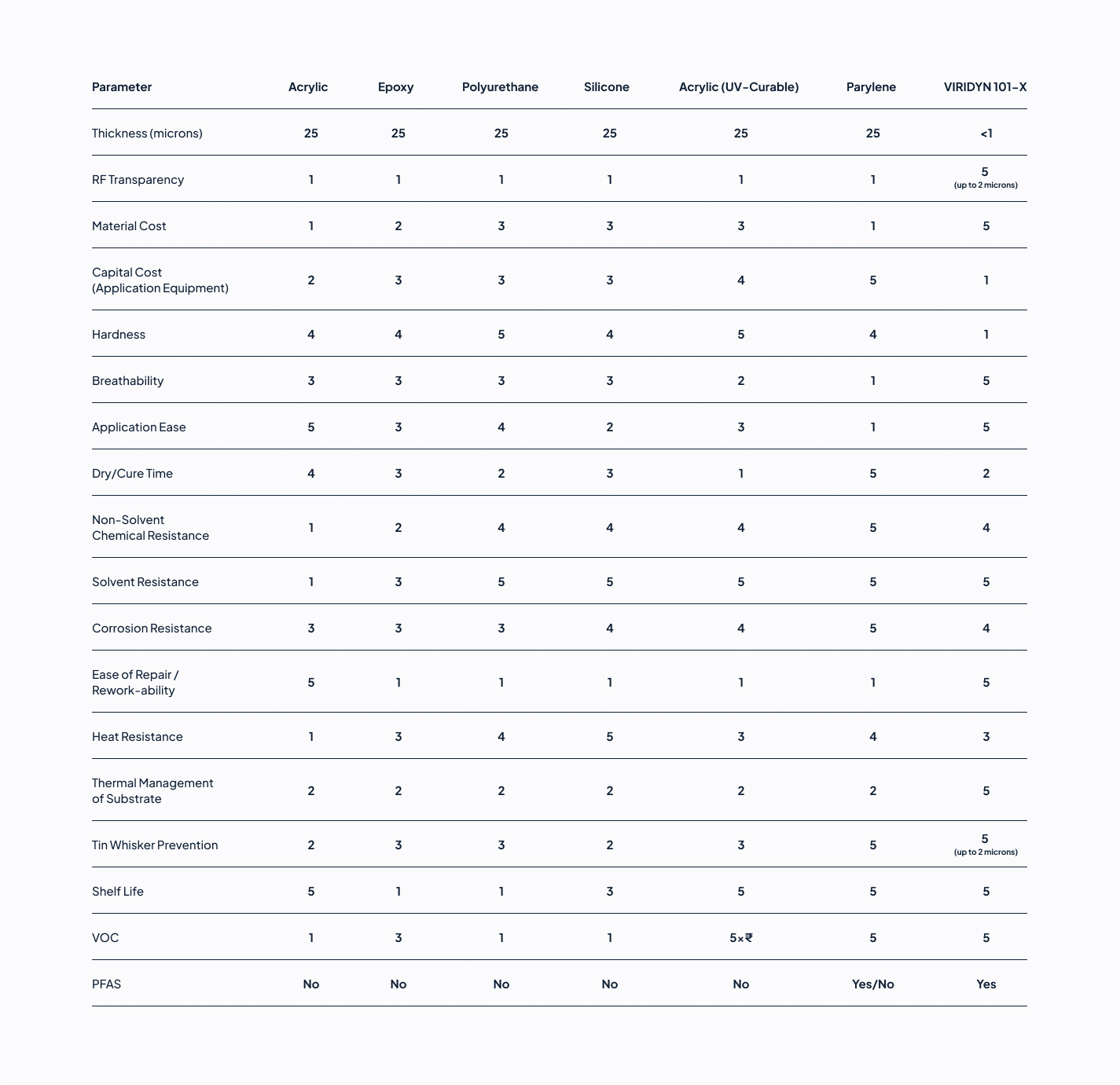
Traditional conformal coatings — acrylics, silicones, polyurethanes, epoxies, parylene — have been the default for decades. ViriDyn’s conformal nano-coatings are a different category: thinner, easier to apply, and in many respects better performing. Here’s how they compare.
Scores are on a 1–5 scale. 5 = Highest, 1 = Lowest.
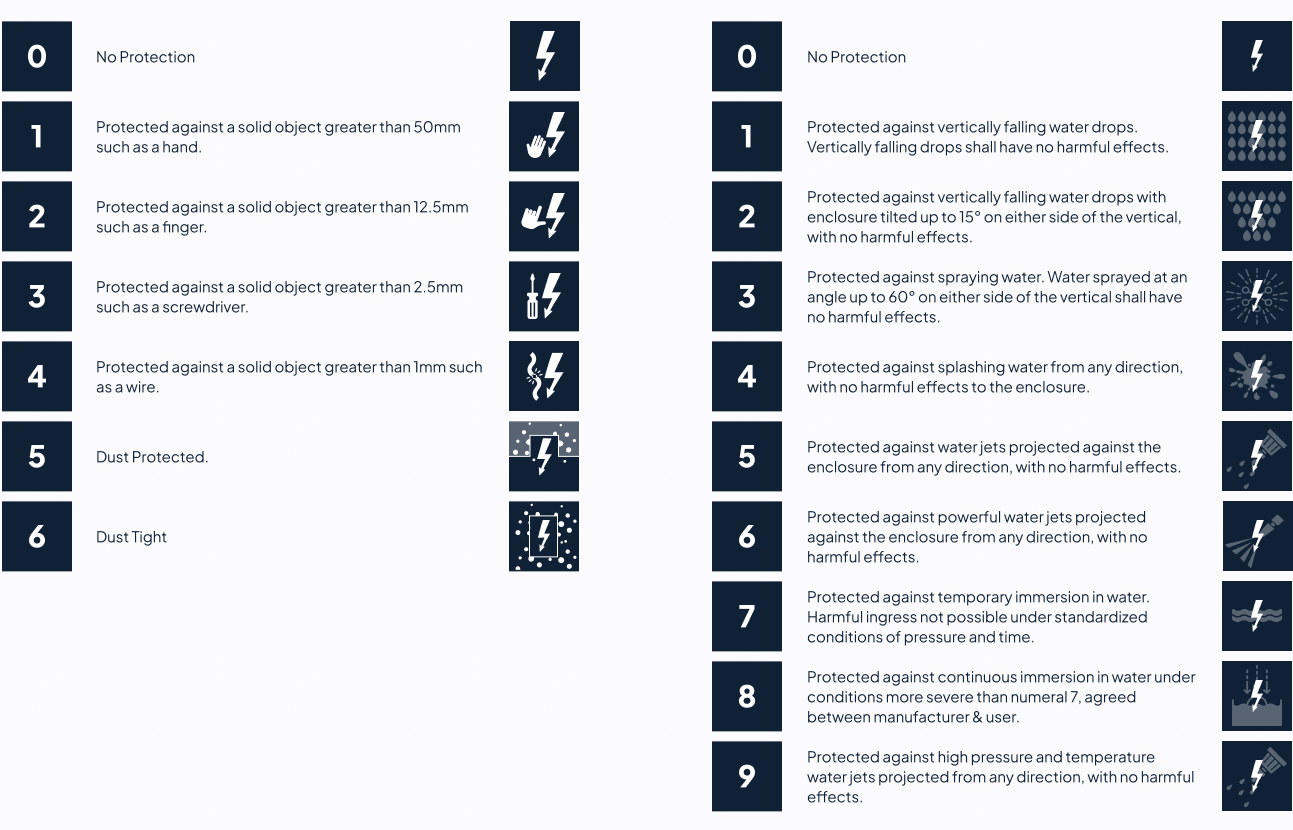
Ingress Protection (IP) Ratings Guide
IP Ratings are represented by combining the first and the second digits of the Below Column.
The Sensornet Way
Right product. Right application. No guesswork.
Most surface failures aren’t chemistry failures — they’re specification failures. Tell us what you’re building, where it operates, and what’s going wrong. We’ll tell you exactly which product fits, and why.